

FloatMaster
EPS Marine Buoyancy
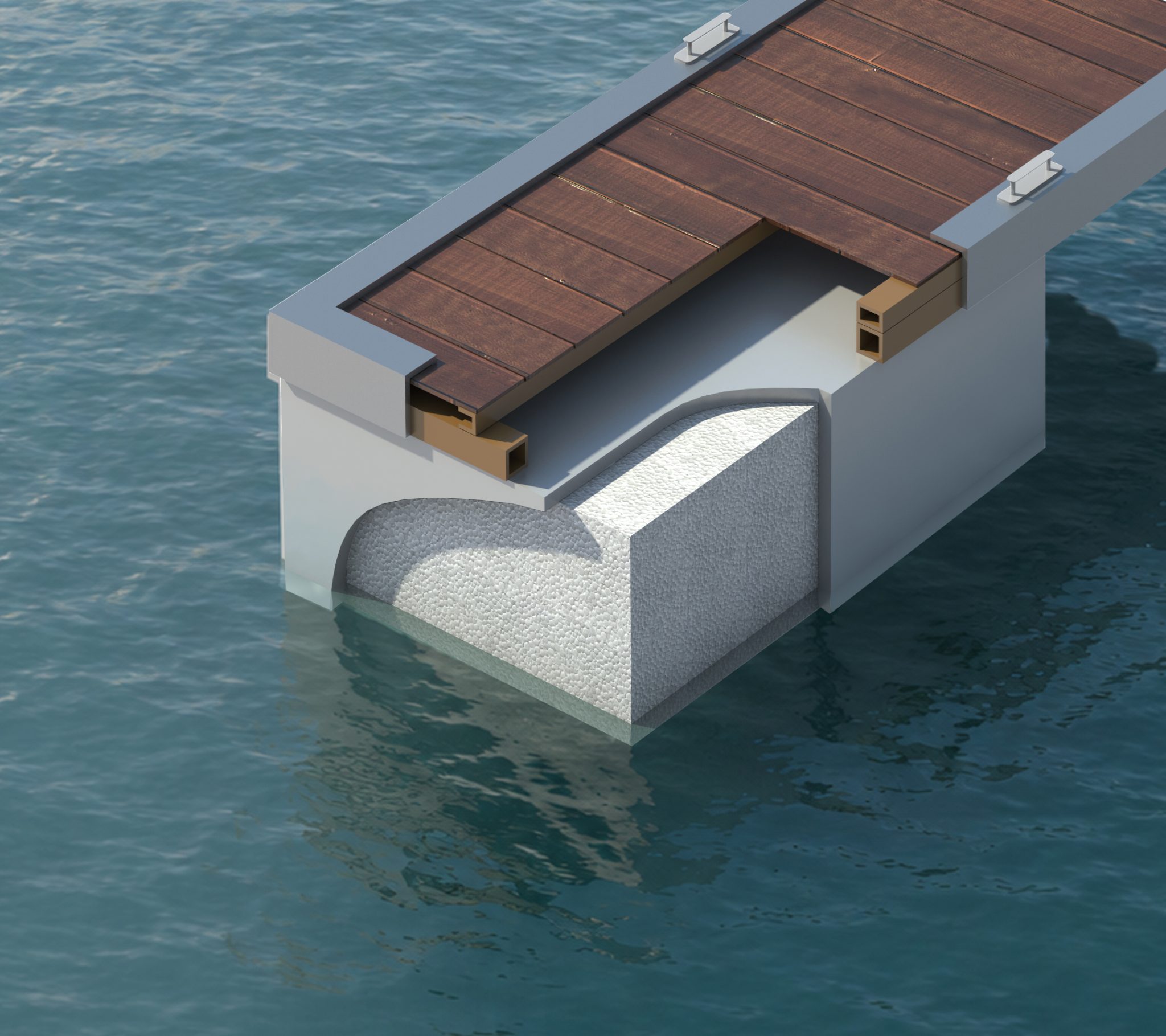
| BEWI FloatMaster is a high-performance, closed-cell expanded polystyrene (EPS) solution engineered specifically for floating infrastructure, including marina pontoons, floating safety booms, and marine platforms. Designed for durability and reliability, it serves as an advanced alternative to traditional, complex buoyancy systems. |
Key Benefits
|
Technical Considerations
When specifying FloatMaster/EPS for marine pontoon applications, it is crucial to understand how density influences buoyancy. While all grades of FloatMaster are highly buoyant, their performance characteristics vary slightly based on the grade selected.
The Relationship Between Density and Buoyancy
FloatMaster is categorized by grade, ranging from EPS 70 to EPS 300 to achieve higher structural strength. Because highergrade blocks contain more material, they are slightly heavier, which results in a marginal decrease in net flotation capacity compared to lower-density blocks of the same volume.
Engineering Considerations
In professional marine engineering, these variations are managed by applying a conservative “effective” buoyancy factor. For the BEWI FloatMaster range, this is typically standardized at approximately 900kg/m3.
This value is intentionally conservative, sitting below the theoretical buoyancy of water to account for two specific factors:
1. Self-Weight: The inherent mass of the FloatMaster block, which fluctuates based on the chosen grade.
2. Water Uptake: An allowance of 8 – 10% for water absorption during permanent submersion.
Recommendation: When selecting the appropriate EPS grade for your project, prioritize the compressive and shear strength required to withstand the maximum anticipated loads on your pontoon structure, rather than optimizing for buoyancy variance alone. For assistance with load calculations or grade selection, please consult our technical team.
Typical Buoyancy Calculation Example
Total Imposed Load: 25,000 N = 25 kN
Buoyancy Force ≈ Weight Density of Water: 900 kg/m3 ≈ 9 kN/m3
1. Determine Required Submerged Volume
(Total Imposed Load / Weight density of water):
25 kN / 9 kN/m³ = 2.78 m³
(For the pontoon to float, 2.78 m³ must be submerged.)
2. Verify FloatMaster Capacity:
Hypothesis: Using a pontoon configuration of 8 EPS
blocks, each 1.2 m x 1.2 m x 2.4 m:
– Total EPS Volume: 8 x 3.456 m3 = 27.648 m³
– EPS Surface Area: 8 x 2.88 m2 = 23.04 m²
3. Calculate Actual Submerged Height:
2.78 m³ / 23.04 m² = 0.12065 m
(The EPS will be submerged by approximately 120.65
mm. Since this is well within the total block volume, this
configuration is suitable.)
Physical Properties & Performance
| Composition: | Closed-cell Expanded Polystyrene (EPS) |
| Grades | Available in grades ranging from EPS 70 to EPS 300 |
| Dimensions | Avilable in: 2400mm (L) x 1200mm(W) x 1200mm (T) Custom factory-cutting sizes are available upon request. |
| Installation Efficiency: | Engineered for precision fitment to maximize buoyancy performance beneath deck surfaces |
Buoyancy Performance by Grade
| EPS Grade | EPS 70 | EPS 100 | EPS 150 | EPS 200 | EPS 250 | EPS 300 |
| EPS Density (kg/m3) | 15 | 20 | 25 | 30 | 35 | 38 |
| Net Buoyancy (kg/m3) | 985 | 980 | 975 | 970 | 965 | 960 |
| 8% Water Absorption Allowance (kg) | 78.8 | 78.4 | 78.0 | 77.6 | 77.2 | 76.8 |
| Total Effective Buoyancy (kg/m3) | 906.2 | 901.6 | 897 | 892.4 | 887.8 | 883.2 |
| Typical Shear Strength (kPa) | 55 | 758 | 100 | 125 | 170 | 225 |
Sustainability:
The Greenline Advantage
BEWI FloatMaster can also be supplied using BEWI Greenline. This range reflects our commitment to a circular economy, featuring:
Recycled Content: Produced using recycled EPS products, such as collected fish boxes and packaging, to minimise waste.
Reduced Carbon Footprint: Engineered with a lower environmental impact compared to virgin materials. BEWI Circulum® Balance: We utilise EPS raw material grades derived from recycled feedstock to ensure consistent, sustainable quality.
Downloads — FloatMaster

Sales Office